
Accelerated loopback network device
SuperSockets also provide significant performance improvement for applications running on a single computer
Most business oriented networked applications use the Berkeley Sockets API to communicate with other applications or server processes. The socket API enables programmers to establish reliable connections – to applications running on servers on the other side of the world, using the Internet – to applications running on other servers in the data room, using a local LAN or a high speed interconnect solution such as Dolphin Express – or to applications running on other CPUs in the same server. Socket communication within servers are established through the special loopback device or through the use of its own host IP address / hostname or local address (typical 127.0.0.1 / localhost).
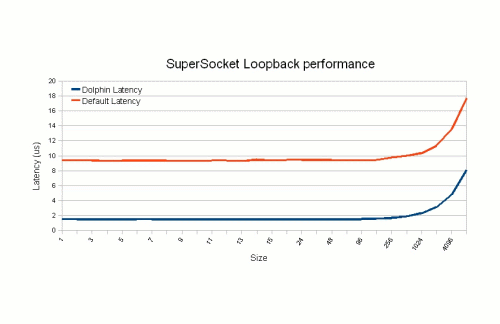
Local socket communication within the server is normally a software only solution implemented by the operating system networking software stack and avoids the use of Ethernet cards. Local socket communication is faster than communicating to remote servers, typical 1 byte ping pong half latency on fast servers is in the range of 9 us or higher.
Optimized socket communication
Newer SuperSockets software from Dolphin has been enabled to also support local socket communication, reducing the local loopback cost from 9 us to 1.5 us. Measurements show that the large message throughput increases up to 6 times. The accelerated loopback solution is automatically enabled when the PCIe adapter card is installed and the SuperSockets software is configured.
MySQL runs faster
Significant MySQL speedup has been reported both for single instance MySQL and for MySQL Cluster.
The optimized loopback solution is available when a Dolphin Express IX, PX or MX card is installed with SuperSockets. The loopback operation does not require a cable to be installed.